

AI for MDR Compliance: From Manual Firefighting to Structured Audit Readiness
For many small and mid-sized medical device manufacturers, MDR compliance looks manageable on paper. The regulation is structured. The annexes are defined. The expectations of Notified Bodies are documented.
1. Introduction: The Hidden Complexity of MDR Compliance
For many small and mid-sized medical device manufacturers, MDR compliance looks manageable on paper. The regulation is structured. The annexes are defined. The expectations of Notified Bodies are documented.
Yet in practice, compliance under the EU Medical Device Regulation (MDR 2017/745) is rarely linear.
Documentation grows over years. Versions multiply. Clinical evidence evolves. Risk management files are updated independently from technical documentation. When audit season approaches, teams suddenly realize how fragmented their documentation landscape has become.
What makes this challenging is not the regulation itself. It is the interaction between:
Technical documentation MDR requirements
Clinical evaluation updates
Post-market surveillance data
Risk management and design controls
CE marking documentation alignment
Changing expectations from Notified Bodies
This is where AI for MDR compliance is starting to change the operational reality — not by replacing Regulatory Affairs professionals, but by supporting them in managing complexity.
2. Why MDR Documentation Has Become More Complex Since 2021
Since full MDR application in May 2021, documentation requirements have intensified in three key areas:
1. Clinical Evidence Depth
Notified Bodies now expect stronger clinical justification, more systematic literature searches, and tighter alignment between claims and data.
2. Traceability
Risk management, clinical evaluation, usability engineering, and post-market surveillance must be tightly linked. Gaps are quickly identified.
3. Living Documentation
MDR documentation is no longer static. PMS, PSUR, and vigilance data continuously feed back into the technical file.
For many companies, this means:
Larger technical documentation files
More cross-references between documents
More frequent updates
Increased audit scrutiny
Even experienced RA teams report that preparing CE marking documentation under MDR takes significantly longer compared to the former MDD framework.
The complexity is structural — not temporary.
3. The Real Cost of Manual MDR Compliance
When MDR compliance remains document-centric and manual, the cost is often underestimated.
Time
Regulatory teams in mid-sized companies frequently spend:
40–60% of their time on document coordination
Manual cross-checking of risk files and CER updates
Formatting and reformatting documents
Audit preparation tasks
In practical terms:
Updating a Class IIb technical documentation file can take 4–8 weeks of focused effort
Literature review updates often require 30–50 hours per cycle
Internal pre-audit reviews can consume 1–2 full weeks per product
This time is not spent on strategy. It is spent on alignment and verification.
Audit Risk
Manual systems increase the likelihood of:
Inconsistent references
Outdated annex links
Misalignment between risk controls and IFU claims
Missing justifications
These inconsistencies often translate into Notified Body findings such as:
Minor non-conformities due to missing traceability
Requests for clarification on clinical claims
Delays in certification timelines
Each finding extends review cycles — sometimes by months.
Consultant Dependency
Many SMEs rely heavily on external consultants for:
Clinical evaluation report reviews
MDR audit preparation
Technical documentation MDR restructuring
While consultants are valuable, over-dependence increases:
-
MDR compliance cost
-
Internal knowledge gaps
-
Certification delays when consultants are unavailable
-
The result: compliance becomes reactive and expensive.
4. Where AI Changes the Game in MDR Compliance
AI does not eliminate regulatory responsibility. It augments regulatory expertise in three practical ways.
AI as Assistant: Audit Review & Validation
One of the most immediate applications of AI for MDR compliance is structured document validation.
Instead of manually cross-checking:
-
AI can compare risk controls with IFU statements
-
Identify inconsistencies between CER conclusions and marketing claims
-
Flag missing references across documents
-
Highlight incomplete Annex II elements
Example:
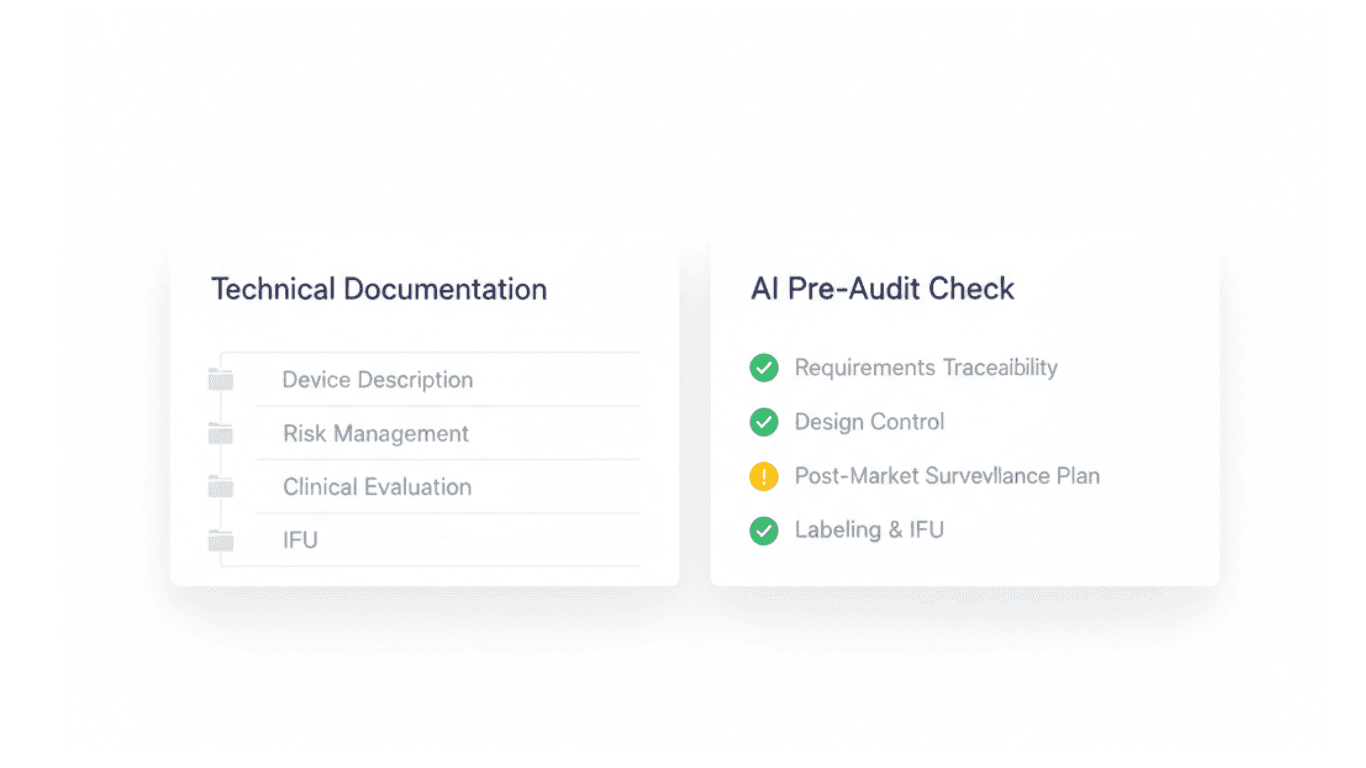
A company preparing for MDR audit preparation runs its technical documentation through an AI audit checker.
The system identifies:
Two claims in the IFU not supported in the CER
A risk control listed in the RMF but missing in verification evidence
An outdated harmonized standard reference
Time saved: approximately 60–70% of manual pre-audit review time.
The RA team remains in control — but works with structured guidance.
AI as Agent: Clinical Research Automation
Clinical evaluation under MDR is labor-intensive.
AI can support:
Structured literature searches
Initial screening of abstracts
Classification of relevant vs. non-relevant publications
Draft evidence mapping
Instead of reviewing 300 abstracts manually, AI pre-screens them based on defined inclusion criteria.
Regulatory professionals then:
-
Validate relevance
-
Review flagged studies
-
Make final clinical judgments
Typical time reduction: 30–50% for literature review preparation, without compromising regulatory oversight.
AI as Co-Pilot: Guided CE Documentation Process
Many SMEs struggle with structuring CE marking documentation in alignment with Annex II and III.
AI-supported systems can:
Guide users through required documentation blocks
Ensure structural completeness
Maintain traceability between risk, clinical, and PMS elements
Flag missing mandatory sections
Rather than relying on static templates, teams work within a structured, interlinked environment.
This reduces:
Structural gaps
Redundant documentation
Late-stage restructuring before submission
It also reduces MDR compliance cost by decreasing rework.
5. How AI Reduces Notified Body Findings Before Submission
Notified Body findings frequently stem from three issues:
-
Inconsistency
-
Lack of justification
-
Missing traceability
AI-based audit checking can proactively address these.
For example:
Before submission, a structured AI review may detect:
-
Claims not backed by clinical evidence
-
Unlinked risk controls
-
Incomplete PMS feedback loops
-
Discrepancies between design inputs and final specifications
Companies using AI-supported internal audit checks often report:
-
Fewer minor findings
-
Shorter review cycles
-
Faster response times to clarification requests
While no system can guarantee zero findings, structured pre-submission checks can realistically reduce avoidable documentation findings by 20–40%.
6. Practical Example: Preparing for an MDR Audit with AI Support
Consider a mid-sized Class IIb device manufacturer preparing for a surveillance audit.
Traditional Approach
2–3 weeks of internal document review
Manual cross-checking of technical documentation MDR structure
Consultant pre-review
High stress before audit
AI-Supported Approach
Step 1: Upload technical documentation into structured system Step 2: Run AI validation checks Step 3: Receive flagged inconsistencies Step 4: RA team reviews and resolves findings Step 5: Generate structured audit checklist
Outcome:
-
Pre-audit review time reduced from 3 weeks to approximately 8–10 working days
-
Improved confidence in traceability
-
Reduced consultant hours
-
The RA team still makes all regulatory decisions. AI simply accelerates verification.
7. What to Look for in AI MDR Compliance Software
Not all AI tools are suitable for regulated environments.
When evaluating AI for MDR compliance, consider:
1. Traceability
Does the system maintain links between risk, clinical, PMS, and technical documentation?
Can findings be documented and justified?
2. Audit Transparency
Are AI checks explainable?
Can you document why a conclusion was made?
3. Data Security
Is the system hosted in the EU?
Are document access controls robust?
4. Structured MDR Alignment
Is the system aligned with Annex II and III requirements?
Does it support CE marking documentation structure?
5. Human-in-the-Loop Design
AI must:
Support RA professionals
Allow overrides
Document expert decisions
If a system tries to “automatically generate compliant documentation” without expert validation, it is unsuitable for regulated use.
AI is an assistant, not a PRRC.
8. Conclusion: From Reactive Compliance to Intelligent Compliance
MDR compliance is unlikely to become simpler. Clinical expectations are rising. Notified Body scrutiny is increasing. Documentation volumes continue to grow.
The question is not whether AI will replace regulatory professionals. It will not.
The real question is:
Will regulatory teams continue spending most of their time on manual cross-checking and formatting — or shift toward structured, intelligent oversight?
AI for MDR compliance enables:
-
Faster MDR audit preparation
-
Lower MDR compliance cost through reduced rework
-
Improved consistency in technical documentation MDR
-
Fewer avoidable Notified Body findings
-
More focus on strategic regulatory decisions
For small and mid-sized manufacturers, this shift can mean the difference between reactive compliance and controlled, audit-ready operations.
If you are preparing for an MDR audit or reviewing your current CE marking documentation, it may be worth exploring how AI-supported audit checking can strengthen your internal review process — before your Notified Body does.